
Wanting Art You Can't Have
On longing, letting go, and what the ones that get away actually teach you
I ate lunch in my high school library because I loved the smell of books and the particular quiet of a room where people were supposed to be thinking. The librarian noticed me, the way good librarians notice things, and what she noticed specifically was that I kept looking at the same posters in a pile on the card catalog (Gen Z, this is how we used to find books— in a large rolodex style cabinet with index-card like pieces of paper with the Dewey Decimal system). They were large, maybe 60 by 48 inches, cardstock reproductions of famous works — the kind of thing printed in the 70s or 80s for institutional use. I must have rifled through them enough times that she decided I needed them more than the heap of forgotten ephemera did. She gave them to me.
Those were the first works of art I ever owned. Reproductions, not prints. Not even close to the real thing. But I carried them home and put them up, and I didn't know yet that there was a difference between what I had and what hung in museums, because I had never been close enough to anything original to feel it.
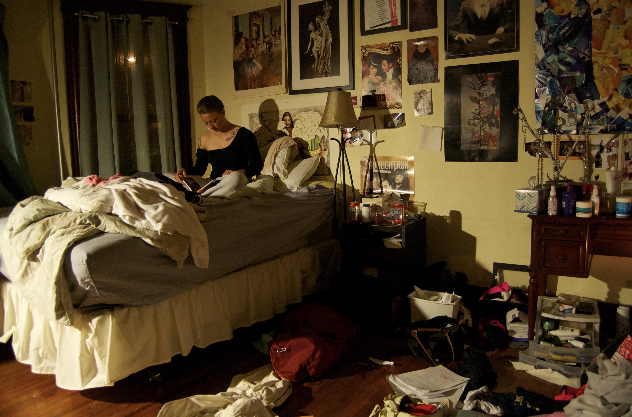
An actual picture of my living room-turned-bedroom in grad school with some of the posters from high school.
For most of my early life, I assumed the art I loved — the work I studied in textbooks, encountered in institutions, wrote papers about — existed in a category permanently separate from my own. Something to be looked at, not held. Reserved for people with a different kind of access than I had. It took working inside galleries, being gifted pieces by artists, watching real collectors operate at every price point, to understand how wrong I was. Some of the most genuinely engaged collectors I've encountered were buying modestly, directly from living artists, betting on someone's vision before anyone else had validated it.
The first piece I bought that I actually remember is a commission from my friend Elizabeth Horne, a painter who is still making work today. At the time it was more money than I had comfortably spent on anything that wasn't strictly necessary. I believed in her and I gave her the money and she made something inspired by our friendship, our history together. She wrote me a poem to go with it. The poem still hangs at my entryway. The painting is somewhere I see it every day. That's where it started for me — not with a blue-chip name or an auction record, but with someone I knew and trusted and wanted to support before the world caught up.
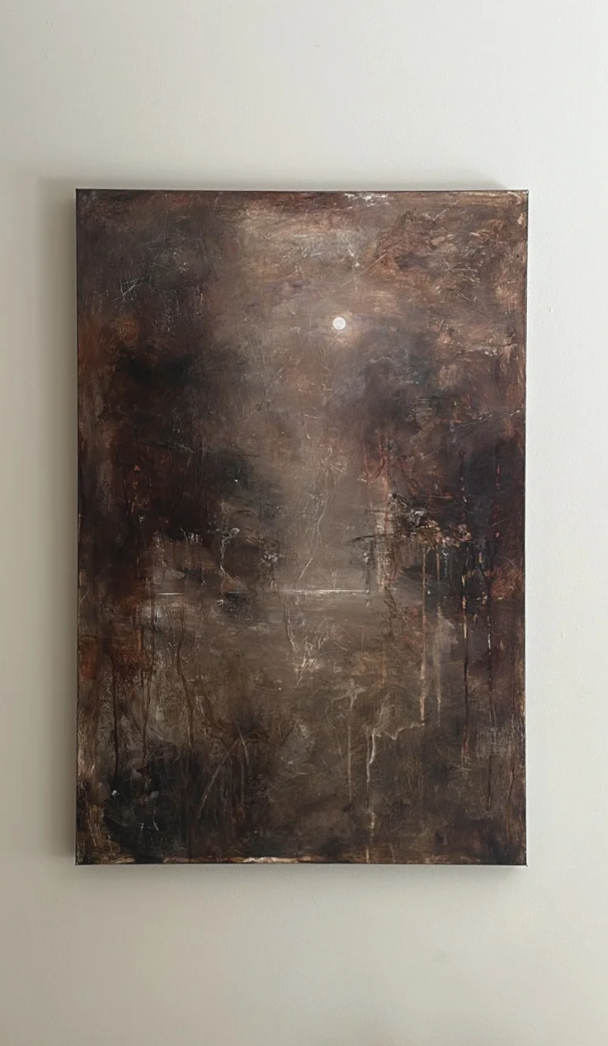
An example of Lizzie's work from her website that I love.
Since then, I have fallen in love with art every single day. I mean that literally.
It is, as I tell people, both a blessing and a curse. A blessing for my clients, because I carry a genuine, wide, occasionally inconvenient love for a huge range of artists and can speak about them from something real. A curse for my bank account, for reasons I don't need to elaborate on.
What I've learned, after years of this, is that knowing the market doesn't kill the feeling. It changes it. When I see something now that I love and can't have — at a fair, in a gallery, in a PDF that arrives on a Tuesday and ruins my afternoon — I can locate why I love it more precisely than I used to. I can be glad for an artist who is operating outside my reach and understand that someone else believed in the same vision I did. That's not as consoling as it sounds in theory. In practice it's actually fine. Better than fine, sometimes.
What hasn't changed is the feeling itself. That specific physical response to a work that is doing something to you — not at you, not for you, but to you. For me it lives somewhere between the gut and the skin. My eyes stop blinking. I'm aware of not wanting to look away in case I miss something in the piece. That feeling is not replicable. It's not transferable to a reproduction or a photograph of the work or even a very good memory of it. It's the reason people still go to museums when they could look at everything online. The real thing does something the image of the real thing cannot.
That feeling is what I'm always chasing. Not the same feeling identically — I'm not looking to replicate a specific experience — but that depth. That full-body knowing that something is working on you.
There is one that got away that I still think about.
It was a photograph by Aaron Siskind. Martha's Vineyard, late 1930s. A gelatin silver print, small, the kind of thing that arrives in an auction catalog between two other lots and asks nothing of you. The title was something like Fish in Hand or Man with Fish. Heritage Auctions. Estimated in the hundreds. Sold for around $1,500.
I watched it. I didn't bid.
The image was a hand — clearly weathered, the fingernails carrying dirt, the kind of hand that has done physical work for decades — holding a small dead fish. The fish sat in the valley between the fingers and the palm. You could see the lines of the palm, the texture of each fingertip, the scales of the fish. The fish's eyes were bright. Bright eyes on a dead thing, held in a tired hand, in black and white, on Martha's Vineyard, which is a place that means something particular and personal to me.
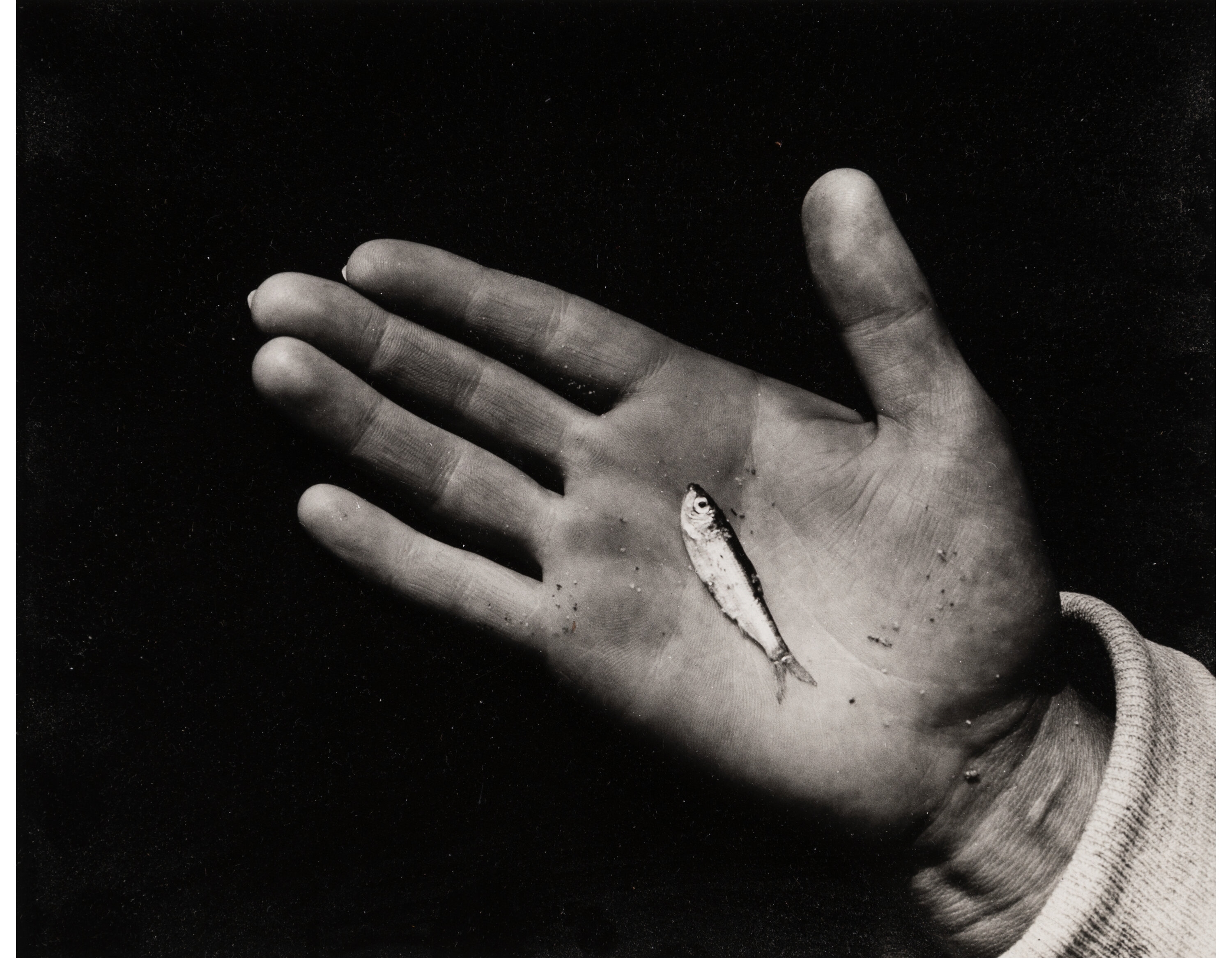
Aaron Siskind, Fish in Hand, Martha's Vineyard, taken 1939
Every sign was pointing at me. The medium — black and white photography is what I collect most. The image itself, which sounds like nothing when described verbally and was everything when I looked at it. The location. The price. I didn't take the jump and I have thought about it since.
I know now which museum collections hold Siskind's work. I have inquired about other pieces by him. The ones available are well outside what that auction lot cost. I have not found another one like it.
Here is the thing I've made peace with: I probably appreciate that photograph more for not having it. Possession and appreciation are not the same thing, and sometimes the wanting is the clearest signal you have that your eye is working. That specific convergence — the medium, the image, the meaning, the physical response in your body when you look at it — that's the thing you're looking for. Not that photograph specifically. That feeling. And it will come again, in something else, in front of something I haven't seen yet.
When it does, I'll know. And maybe that time, I'll make it mine.
What's the one that got away for you? I'd genuinely like to know — reply and tell me.
