
What a Life Does to an Artist
On first works, final works, and everything the distance between them tells you
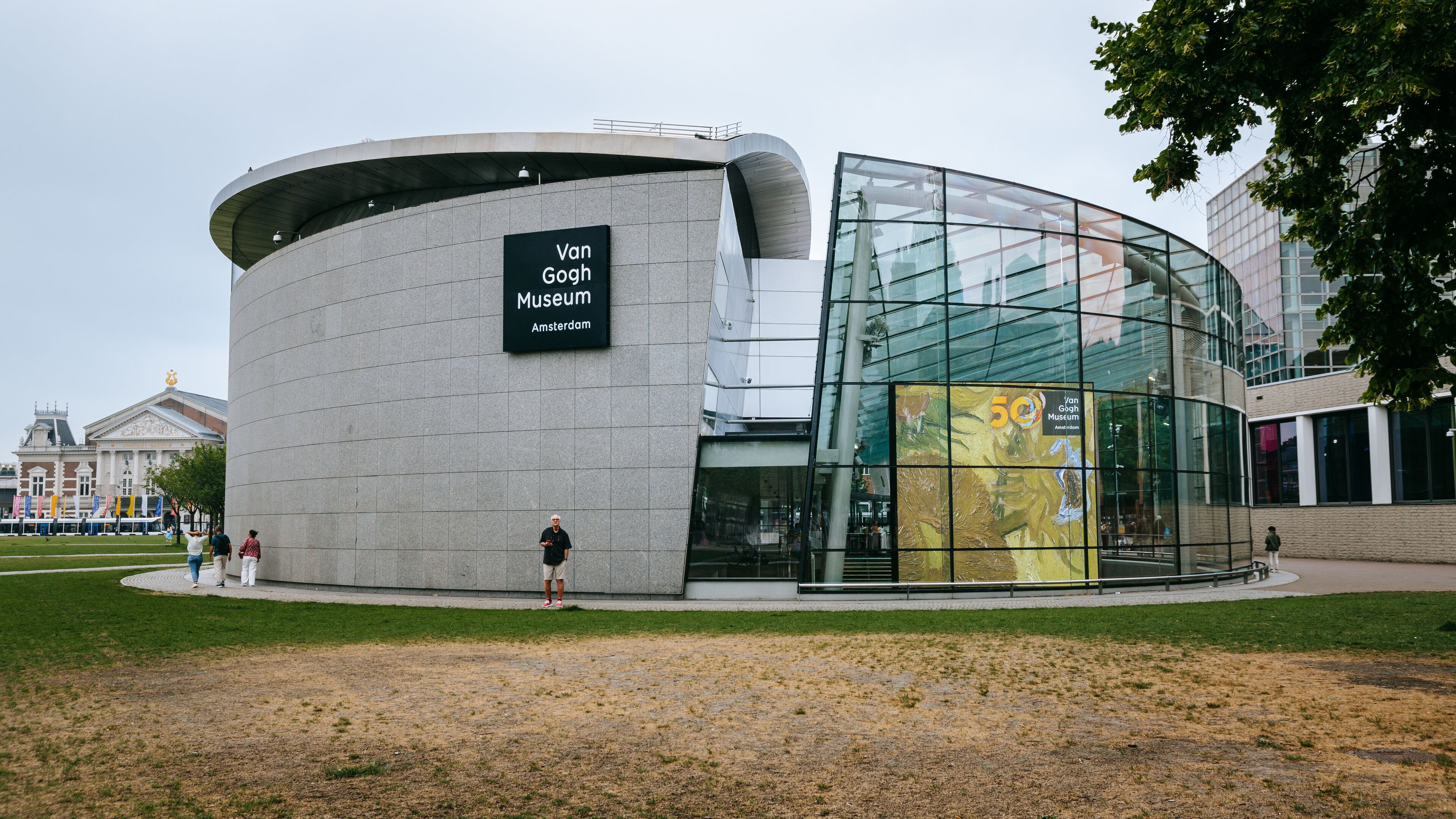
There's a staircase at the Van Gogh Museum in Amsterdam that I still think about.
You enter the exhibition at street level and move chronologically through a life. The early work. The Dutch period. The letters. The move to Paris, the color opening up. And then, somewhere near the top of the building, you file upstairs in a single-line procession toward the final room. By the time I arrived at Wheatfield with Crows — that dark, horizontal canvas from July 1890, crows lifting off the field into a bruised sky, the path leading nowhere — I already knew what was coming. I had studied this. I understood the critical consensus, the biographical arc, the letter to Theo. None of it prepared me for what it felt like to be in that room, watching other people understand it in real time.
The woman next to me exhaled. A man stopped walking entirely.
That's the thing about seeing an artist's work in full, chronological sequence. A single painting asks you to feel something. The distance between first and last asks you to reckon with what a life actually does to a person.
I've been thinking about this since visiting the Alex Katz retrospective at the Guggenheim a few years ago. The show was called Gathering, and it used the Frank Lloyd Wright rotunda exactly as it was designed to be used: you start at the ground level and walk up the spiral, chronologically, until you arrive at the most recent work at the top. The early Katz is site-specific, moments in time with very specific places and people. Almost photogenic, in a way. Portraits with a warmth and brushiness that his later work shed almost entirely. By the time you reach the upper floors, you're looking at something spare, monumental, almost severe — faces cropped like billboards, flat color, radical economy of line. The man is 97 years old and still painting. He got here on his own terms, celebrated for decades, working from studios in New York and Maine, painting the same people he has always loved.

Ground floor of Gathering at Guggenheim. I was excited, to say the least.
Two different rotundas. Two completely different lives. One artist who died at 37, unknown and unstable, having sold almost nothing. Another who has outlasted every movement he was ever adjacent to and watches his prints sell at auction for more than most painters' originals. And yet in both cases, the experience of moving through the work in sequence produced something I can only describe as an understanding that felt physical.
What I keep returning to is not the style changes but what caused them.
Georgia O'Keeffe began her career in New York under the influence of Alfred Stieglitz — professionally, romantically, and in ways that were almost impossible to disentangle. The early work is sensuous, biomorphic, charged. Then she started going to New Mexico. She drove solo across the badlands, painted from the seat of her car, collected specimens from the desert floor. She made New Mexico her permanent home in 1949, three years after Stieglitz's death. The late work is something else entirely — aerial cloud paintings, a woman looking down at the world from above, almost blind by the end and still insisting on making things. The removal was not a retreat. It was a clarification. She stripped everything that wasn't essential, including the people who had defined her context, and found out what she was actually trying to say.
Jean-Michel Basquiat went the other direction. He came up from nothing — sleeping in Tompkins Square Park, selling postcards on the street — and his early work has the urgency of someone who has something to prove and not much time. The raw line, the crossed-out words, the figures that look like they're trying to escape the canvas. By the mid-1980s he was the most talked-about young artist in New York, famous in a way that the art world produces and then often consumes. The late paintings are more crowded, more anxious. The crossing-out becomes more frantic. He died in 1988 at 27. What the work registers in those final years is not the fulfillment of a career. It is the pressure of one.
Caravaggio never got old enough to have late work in any conventional sense — he died at 38, probably from lead poisoning, after years of fleeing a murder charge across Italy. But the arc in his short output is extraordinary. The early work is dramatic and staged. The late paintings, made in exile in Malta and Sicily, are darker in every sense: less theatrical, more stripped, figures emerging from near-total darkness as if the painter had stopped performing and started confessing. Exile did something to him that comfort never would have.
Artemisia Gentileschi is one of the most instructive cases in the canon precisely because her first major work was made in the aftermath of violence. She had been assaulted and was forced to testify under torture. Judith Slaying Holofernes — painted around 1614 to 1620 — is not a passive mythological scene. It is something else. And then she built an entire career, moved to Florence and London, gained patrons across Europe, became the first woman admitted to the Accademia delle Arti del Disegno. The later work is more technically accomplished, more politically secure. But there is an argument that nothing she made afterward had quite the same heat. You can debate whether what she gained — recognition, stability, freedom of movement — softened the edge or simply changed it.
Helen Frankenthaler started by pouring. Literally — she laid canvas on the floor and poured thinned paint directly onto it, letting it stain and pool without the barrier of a brush. Mountains and Sea from 1952 reads as almost accidental, the landscape arriving through the material rather than being imposed on it. The late Frankenthaler is controlled in a way the early work never was. Fewer colors, bigger gestures, more deliberate. The question with her arc is not which was better. It's what she learned to trust over five decades, and what she learned to let go.
Louise Nevelson was nearly sixty before the art world properly noticed her. Decades of making work, failed marriages, a son she largely left behind, persistent poverty, and then: recognition. The late assemblages — those monumental black walls of found wood, stacked and contained and somehow managing to be both architectural and intimate — arrived after a lifetime of fighting for the room to make them. The early work matters. But the late work is what she had been building toward the whole time, and you only know that looking backward.
Here is what I want to tell you, if you are someone who buys art or wants to:
Most collectors encounter a single painting in a gallery, at an auction, or on a studio wall. They make a decision about that object — its quality, its price, its appeal to them — in near-total isolation. What they are usually missing is the story of the distance. Where did this person start? What happened to them in between? What does this particular moment in their career represent — the arrival, the refinement, the unraveling, the final clarification?
That context doesn't change the painting. But it changes what you're buying. And for anyone building a collection that means something, that difference matters more than almost anything else.
I don't have a prescription for you at the end of this. No ranked list of careers with the tidiest arcs, no formula for reading a first painting against a last one. What I have is a suggestion: go look at the full sequence when you can. Find a retrospective. Walk the rotunda. File upstairs in a single line behind strangers and see what happens to the room when you get there.
The work will tell you something that no gallery checklist ever will.
Who would you add to this list? I'm genuinely curious — reply and tell me which artist's first and last works you find most illuminating. I'll read every one.
