
Art Collecting 101: PART I - Taste Before Purchasing
How to learn what you actually love
Imagine this:
You're headed into a new restaurant alone. Not starving, but not satiated either. The menu is hundreds of pages long, but it doesn't seem to bother you. Seated at tables and barstools around you are panicked patrons, anxiously flagging down any member of staff that can guide through the superfluous options available on hand.
…but you take a satisfied deep breath and wait to place your order.
"What'll it be?" says the overworked and underwhelmed server.
You know exactly what you'll have— because you don't need a list of thousands or even millions of options to decide. Over time, you've tasted and tried, experimented, rejoiced, and definitely spit a few things subtly into your napkin.
The point is, you know what you'll definitely like. But you weren't born with it. You gave yourself the chance to try.
Surprised, the server responds, "Good choice. You have great taste."
And indeed, you do.
I can usually tell, within a few minutes, whether someone is going to become a serious collector.
It has nothing to do with budget or what they already own.
It's in how they look.
And to be clear, it's not just the act of seeing—it's the pauses in front of art. It's the signs and stances they take. It's the slow-burning time invested in the act of really taking in the visual, contextual, and emotional data of an artwork.
It's not in what they say or what they ask—but how long they stay with something. Whether they move quickly, scanning for approval, or whether they pause. Whether they're trying to get it right, or trying to feel something first.
Most people think collecting begins with buying.
It doesn't.
It begins much MUCH earlier, in a quieter place—before price, before access, before confidence—when you're simply learning how to recognize what moves you.
And most people rush past that part.
I've watched it happen hundreds of times.
Someone walks into the gallery, does a quick loop, and lands on the work they think they're supposed to like. The one that feels familiar, or validated, or already agreed upon. They ask the safe questions. They look for signals. They try to align themselves with what makes sense.
And sometimes, they leave with something.
But rarely with something that stays.
Because liking something is not the same as recognizing it.
Recognition is slower. It doesn't always make immediate sense. It interrupts you a little. It asks you to stay longer than you planned. It creates a kind of friction—between what you expected to feel, and what's actually happening.
That's the beginning of taste.
My point in the opening story is this: taste isn't something you're born with.
It's something you build through exposure—and more importantly, through attention.
Museums help. Galleries help. Fairs, studios, even Instagram and Substack. But exposure alone isn't enough. You can see thousands of works and still not know what you love if you're moving too quickly through them.
The shift happens when you start asking better questions.
Not "Do I like this?" But "Why do I like this?"
And forcing yourself to answer it without defaulting to surface-level language.
Not: "the colors are nice" But: what about the color? the temperature? the restraint? the excess?
Not: "this reminds me of something" But: what exactly? where have I felt this before?
Over time, patterns begin to emerge.
You start noticing that you're drawn to a certain kind of tension. Or stillness. Or repetition. Maybe it's figuration that feels just slightly off. Maybe it's work that holds space rather than fills it. Maybe it's density, or the opposite—something spare enough that it almost disappears.
This is the work of forming your taste.
Not buying. Not acquiring. Not amassing a floor-to-ceiling hang of name brand artists.
Of learning your own, unique, internal monologue made real and multi-dimensional through visual language.
If you're at the beginning of collecting, this is where I would spend your time.
Not researching prices. Not trying to understand "what's important." Not asking what you should buy.
Just looking.
Slowly enough that something has the chance to reach you before you explain it away.
Pay attention to what lingers after you leave. What you think about later, without trying. What you can't quite articulate, but don't want to let go of.
That's your starting point.
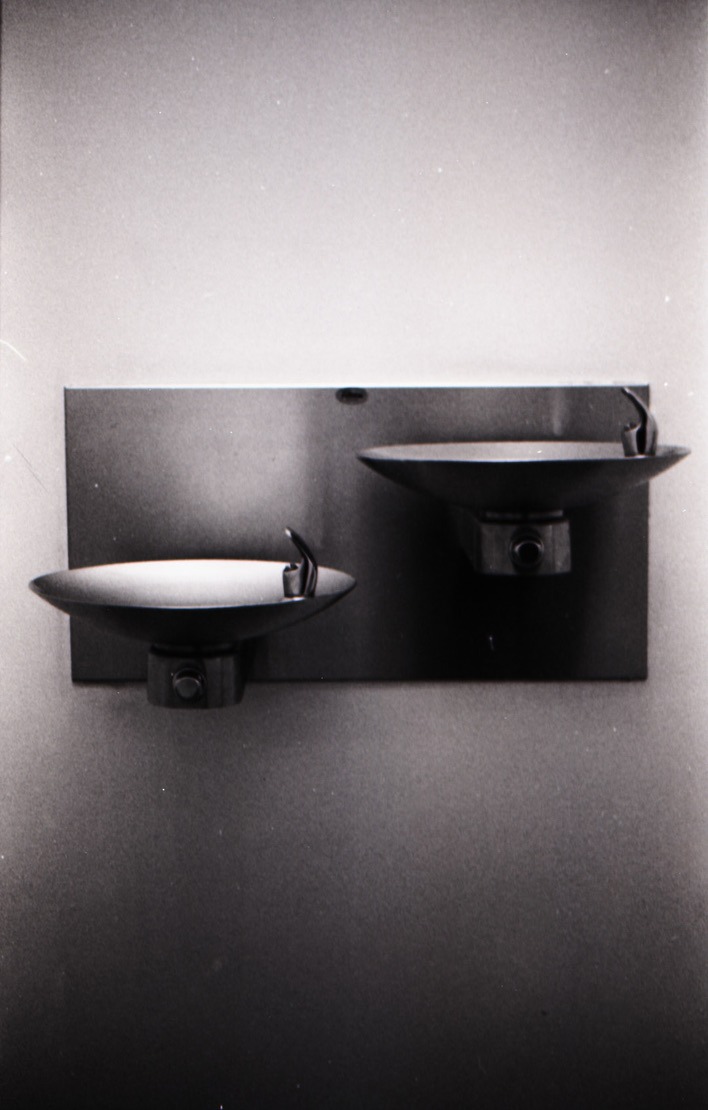
No, not a Duchamp. This is actually just a water fountain at MFA Houston, but both my partner and I noticed it. So much so, she took a photograph. THESE are the moments that stand out, and it's not even trying.
Because the truth is, the most important decisions you'll make as a collector won't feel logical in the moment.
They'll feel like recognition.
And everything that comes after—confidence, clarity, even market awareness—builds on top of that.
Not the other way around.
Continue the Conversation
What are you consistently drawn to right now—even if you don't fully understand why?
Where are you looking most often (museums, Instagram, galleries), and is it helping—or overwhelming—your sense of taste?
What's one work you've seen recently that stayed with you after you left?
