
From Warhol to Walking Sticks
Upcoming International Auction Highlights
Every auction season I end up bookmarking far more lots than I should. Some because they're historically important, some because they're beautifully made, some because they're a little absurd in the best way — and some simply because I'd love to live with them. This round is a mix of all of that: serious modern masters, playful pop culture moments, timeless design objects, and a few pieces that feel like quiet treasures. Undoubtedly, I'd happily add at least one of these to my own collection.
What follows are the works that caught my eye — for their craft, their story, their presence, or just the joy they bring.
Sotheby's
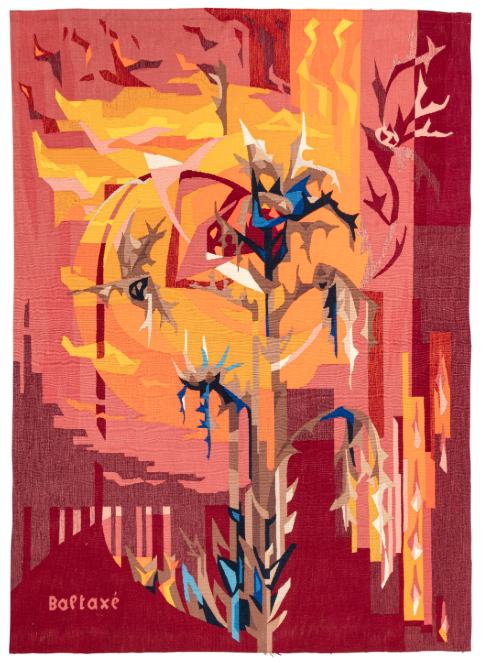
Simone Baltaxé (1925 - 2009), Les Chardons, 1973. Signed (lower left); inscribed and dated 1973 (on the reverse) Wool tapestry 174 x 123.5 cm; 68 ½ x 48 ½ in. Executed in 1973, this work was woven in the workshop of George Audi in Zouk.
Estimate: 40,000 - 60,000 EUR
Catalogue note:
Conceived in 1973, Les Chardons fully embodies the decorative and symbolic ambition of Simone Baltaxé, a singular figure of modernity in the Middle East. Translated here into a wool tapestry, the composition reveals the graphic strength of her pictorial language: a dense network of stylized forms, dominated by a warm palette of reds, ochres, and yellows, animated by the dynamic emergence of the thristle motif. This recurring element in her work becomes a sign that is both organic and heraldic, imbued with strength and resilience.
Woven in the workshop of George Audi in Zouk, this tapestry reflects the close dialogue between modern creation and traditional craftsmanship that characterizes Baltaxé's practice in the 1970s. The scale of the work, combined with the tactile richness of wool, lends the composition a strong physical presence while preserving the narrative impulse distinctive of Baltaxé. Les Chardons thus stands as an emblematic example of the successful integration of tapestry into the field of modern art, offering a work that is at once powerful, decorative, and historically significant.
And in case you, like me, didn't know what a "thristle" was
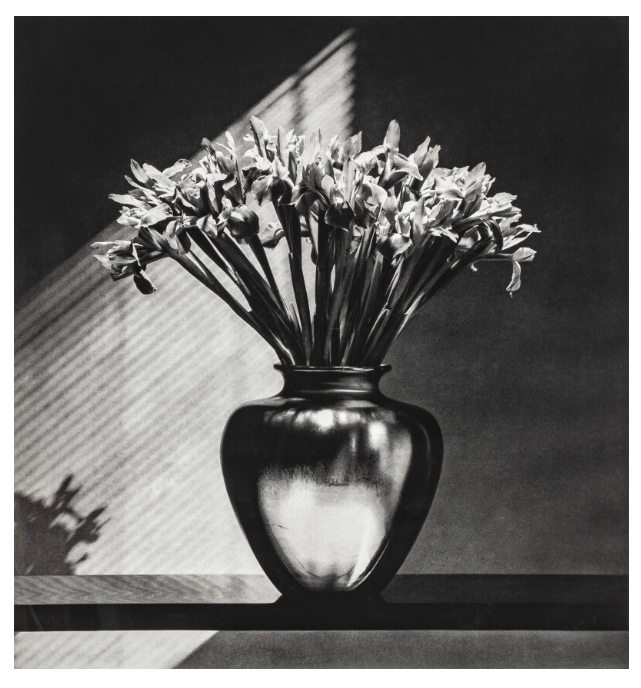
Robert Mapplethorpe (1946 - 1989), Irises (15/30), 1987 Signed, dated 87 and numbered 15/30 in pencil (in the margin) Large-format photogravure 87 x 82 cm; 34¼ x 32¼ in.
Estimate: 40,000 - 60,000 EUR
Mapplethorpe's flowers are never just flowers. In Irises, the sensual precision he's known for is softened by the photogravure process, which lends the image a velvety depth and sculptural calm. The work sits at an intersection Mapplethorpe mastered—formal restraint and erotic charge—without leaning on shock. Large-scale, exquisitely printed, and from a small edition, this is Mapplethorpe at his most composed.
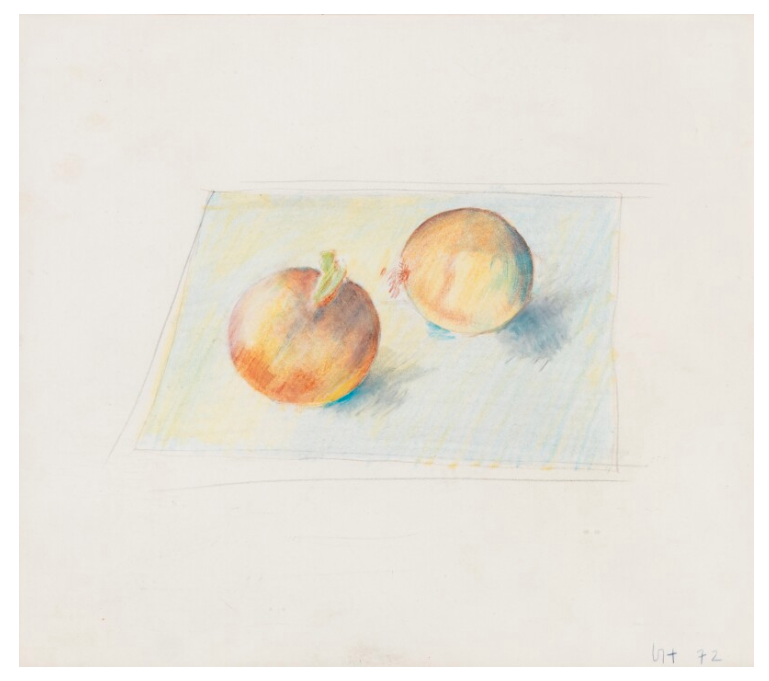
David Hockney (b. 1937), Study of Apples, executed in 1972 Signed with the artist's initials and dated 72 (lower right) Graphite and color pencils 26.5 x 30.4 cm; 10 ½ x 11 ⅞ in.
Estimate: 40,000 - 60,000 EUR
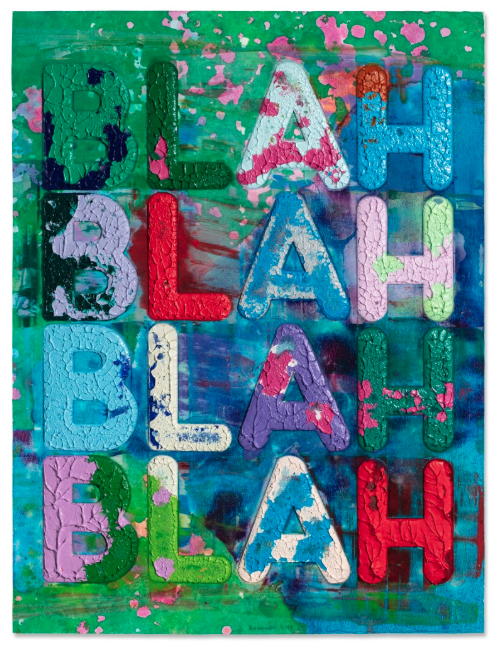
Mel Bochner (1940 - 2025), Blah Blah Blah, signed and dated 2019 (lower centre) Acrylic and gouache on embossed cardboard 74 x 57 cm; 29 x 22 ½ in.
Estimate: 40,000 - 60,000 EUR
Bonhams
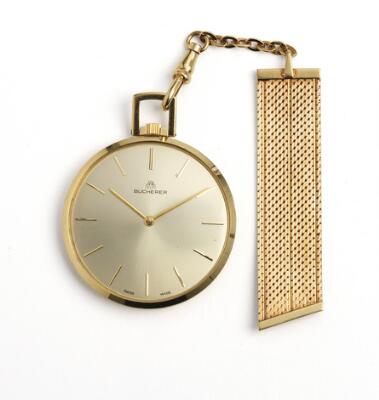
Bucherer Pocket Watch with Gold Chatelaine, 1960s–70s
Pocket watch of 18k gold. Mechanical movement with lever escapement and crown winding. Silvered dial with gold hands. Ø 40 mm. The watch weighs approx. 29.4 grams. Chatelaine of 18k gold. This weighs approximately 13.9 g. 1960–70s.
Estimate: 20,000–25,000 DKK ($3,100–$3,900)
Luxury, before it became performative. This Bucherer pocket watch is precise, beautifully weighted, and refreshingly unapologetic about its purpose. The inclusion of the gold chatelaine completes the object as both timekeeper and adornment. In a world of disposable tech, there's something quietly radical about a mechanical object designed to last—and to be worn with intention.
Christie's
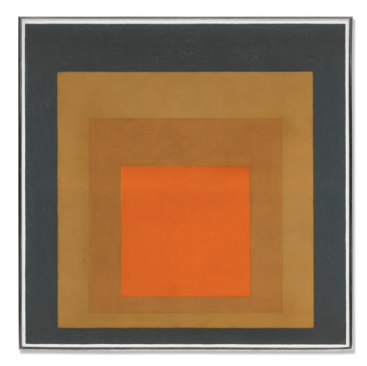
Josef Albers (1888-1976), Homage to the Square: Insight
Albers' Homage to the Square works continue to be among the most intellectually satisfying paintings of the 20th century. Insight is not about color theory as an academic exercise; it's about perception as lived experience. Each square alters the next. Nothing is fixed. The work's power lies in its restraint—and in the fact that it never resolves.
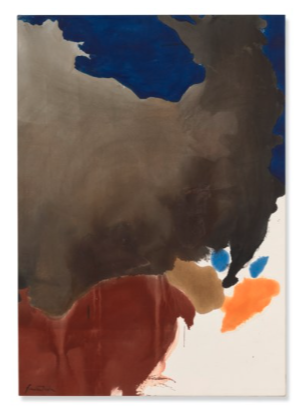
Helen Frankenthaler (1928-2011), Strike
Frankenthaler's paintings feel alive because they are. Strike captures her ability to let color behave—to bleed, soak, and assert itself without force. The work balances spontaneity and control, a hallmark of her best compositions. It's painting as motion, as decision-making in real time.
Heritage Auctions
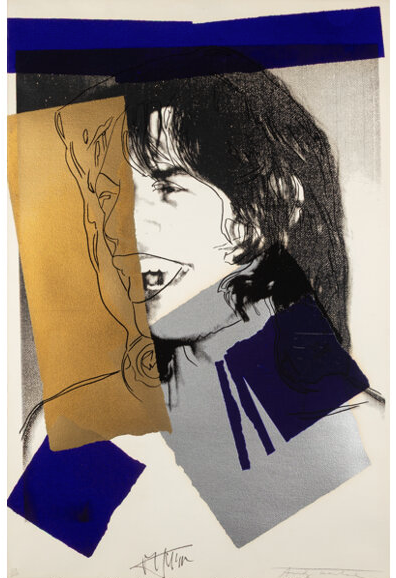
Andy Warhol (1928-1987), Mick Jagger, 1975 Screenprint in colors on Arches Aquarelle paper 43-3/4 x 29 inches (111.1 x 73.7 cm) (sheet) Ed. 37/250 (aside from 50 artist's proofs and 3 printer's proofs) Signed and editioned in pencil along lower edge; with Mick Jagger's signature lower center Published by Seabird Editions, London Printed by Alexander Heinrici, New York
Estimate: $60,000 - $80,000.
Warhol understood fame as a material. This portrait of Mick Jagger is less about likeness than about surface—celebrity flattened, repeated, and made eternal. The addition of Jagger's signature pushes the work into a rare space between image and artifact. It's Pop art doing exactly what it promised: collapsing art, music, and myth into a single object of desire.
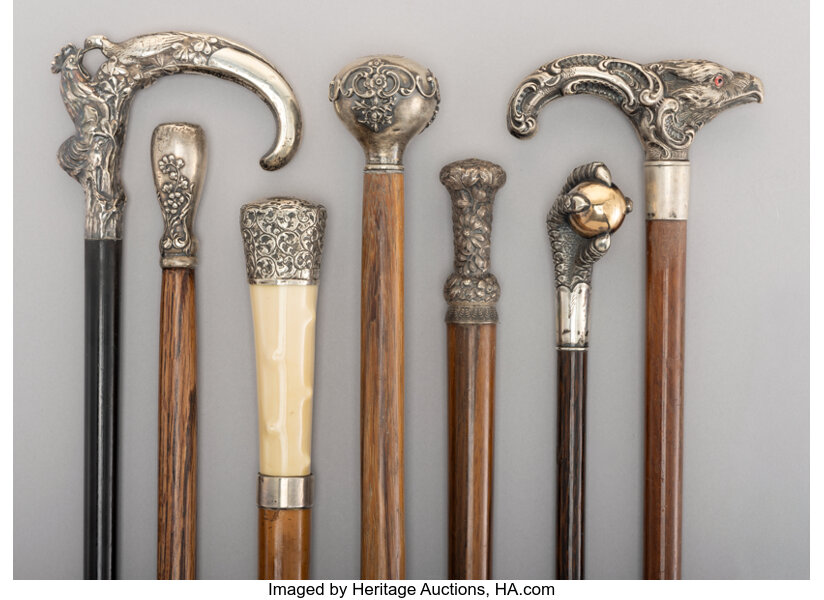
A Collection of Seven Silver-Mounted, Carved Wood, and Bamboo Canes, circa 1893 and later
I'm a big fan of 19th century design and art objects. Would I walk around with these? 100 percent. More than anything: repurposing, re-designing, re-signifying objects like these add to the rich history of collecting. I see these in an antique umbrella vase or hanging in an old-world study.
Marks to tallest: (lion-anchor-G), STERLING, D638 37-1/2 x 2 x 2 inches (95.2 x 5.1 x 5.1 cm) (tallest, Gorham Mfg. Co. cane)
The lot comprising: 1 Gorham Mfg. Co. cane, with monogram FPJ; 1 British cane, London, 1893; 1 Wood & Hughes cane; 1 Whiting Mfg. Co. cane, 1895, with monogram TJM; 1 American mixed metal cane; 1 cane, marked DEPOSE, (undeciphered), 900; 1 cane marked, (3-dog's head), (maker's mark).
7 Total
Estimate: $800 - $1,200.
